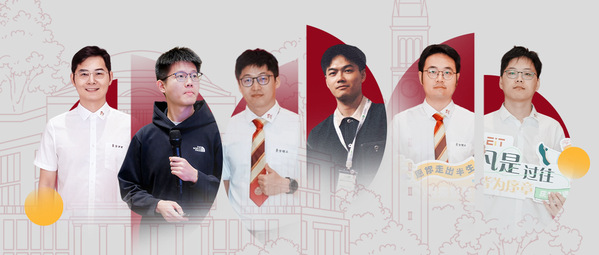
Doctoral graduation often marks the true beginning of an independent research career. For EIT's first cohort of joint-training doctoral graduates, postdoctoral researcher has become the common next stop for many of them —
Some are heading to top institutions at home and abroad, such as Rice University in the United States, the University of Hong Kong, Zhejiang University, and the Chinese Academy of Sciences, while others have chosen to continue scaling academic heights at EIT.
Today, we take a closer look at these graduates who have chosen to keep diving deeper into the academic deep end, listening to the trials and transformations they experienced at EIT, and their thoughts and choices for the future.
Lu Shaoqiang: Blazing a New Path at the Intersection of Hardware and Software
Doctoral research direction: AI-oriented chip design and system optimization
Next stop: Rice University, USA — Postdoctoral Researcher
Lu Shaoqiang still remembers the first time he submitted a paper in his research career. It was during the Spring Festival holiday; though he was at home, his mind was completely occupied by experiments and the manuscript. When the paper was finally accepted, he not only gained confidence but also truly felt —
The first step in research is to make up your mind and complete the 0-to-1 breakthrough as quickly as possible.
Lu's research sits at the intersection of two hardcore fields: integrated circuits and artificial intelligence. What drew him to EIT was his passion for integrated circuits, the deep academic background of Chair Professor He Lei from the Faculty of Information Science and Technology, and the open, vibrant atmosphere of this new research-oriented university.
Witnessing, broadening, growing — he used these three words to sum up his doctoral journey. After publishing one DAC and two ICCAD papers — top conferences in electronic design automation (EDA) for integrated circuits — his most fulfilling achievement was publishing at ASPLOS, a top conference in computer architecture.
I used to think 'top conferences' were far beyond my reach, but once you actually do the work, you realize that with the right direction and solid effort, you have a chance to meet high standards, Lu said.
Facing the rapid advance of AI technology, underlying hardware and software frameworks are confronting new challenges. Heading to Rice University for postdoctoral research, Lu has a clear goal —
I hope to go deep into the intersection of AI systems and chip architecture and solve the bottleneck problems that truly affect efficiency.
Weng Mingxing: Living with the Uncertainty of Research
Doctoral research direction: Computational mathematics and scientific machine learning
Next stop: Academy of Mathematics and Systems Science, Chinese Academy of Sciences — Postdoctoral Researcher
Research often has no standard answer; the greatest growth is learning to think independently and face uncertainty.
Weng Mingxing's research uses neural networks to efficiently solve partial differential equations, enabling computers to simulate complex phenomena in nature and engineering faster and more accurately, thereby reducing the cost of scientific computing and improving computational efficiency. When he first started his doctoral studies, he felt great pressure due to a shift in research direction. But the open and free atmosphere at EIT helped him gradually find his rhythm, and he published a paper as first author in SIAM, a top journal in computational mathematics.
My supervisor, Professor Shen Jie, brought me into the field of computational mathematics and gave me full trust and freedom — whether in research planning or daily life, I could explore and grow in my own way, Weng said.
Outside of research, he is also the knife master in the office who skillfully peels fruit for everyone, preserving a touch of warmth and everyday life amid intense academic work.
With his supervisor's recommendation and help, Weng is about to continue his postdoctoral research at the Institute of Computational Mathematics, Academy of Mathematics and Systems Science, Chinese Academy of Sciences. Over the next three to five years, he hopes to achieve more innovative breakthroughs in using neural networks to solve high-dimensional problems.
Shi Yongkang: Measuring the Swells of Offshore Photovoltaics with Resilience
Doctoral research direction: Large-scale offshore floating photovoltaic systems
Next stop: Zhejiang University — Postdoctoral Researcher
Exploration, resilience, openness — Shi Yongkang used these three words to summarize his doctoral journey.
His research is highly interdisciplinary and cutting-edge — when offshore photovoltaic platforms deform with the waves, how can the impact of such motion on structural safety and power generation efficiency be predicted? His three experiences — at EIT, Shanghai Jiao Tong University, and a visiting period at the University of Queensland in Australia — completely opened up his research horizons.
Shi recalls that in academic presentations at EIT, the teachers most often asked not about technical details but Why does this problem matter? and Where else could this go in the future?
During his doctorate, what Shi found most fulfilling was not any single paper, but gradually developing a set of analytical methods for the hydroelastic response and power generation performance of offshore floating photovoltaic systems.
Beyond his boundless passion for his field, sports are what Shi enjoys most outside of research, and also what he wants to pass on to his juniors.
Sometimes you think about a problem in front of the computer for a long time without figuring it out, but going out to play a game of ball or go for a run gives you new ideas.
With this proactive and open mindset, Shi has gone to Zhejiang University for postdoctoral research. He knows well that in the face of unknown complex sea conditions, only resilience can make research truly take root.
Peng Weike: Finding the Optimal Path for Urban Grid Decarbonization
Doctoral research direction: Decarbonization planning and analysis of high-density urban power grids
Next stop: The Hong Kong Polytechnic University — Postdoctoral Fellow
Choice matters more than effort, but effort earns you choices.
As one of the first joint-training doctoral students, Peng Weike drew dual nourishment from the dual-campus model of EIT and The Hong Kong Polytechnic University, and witnessed EIT's official growth from the Institute for Advanced Study by Tongxin Lake into a new research-oriented university on the banks of the Yongjiang River.
Walking along Dongfang Avenue and watching the Yongjiang shimmer, I feel that I am growing together with the university, Peng said.
During his doctorate, he set his sights on the issue of global climate change — exploring how to reduce the cost of achieving carbon neutrality in high-density cities under a regional coordination framework.
His research findings, using Hong Kong–Guangdong as a case study, were published consecutively in top international journals in the energy field, offering new ideas for extending One Country, Two Systems into the energy and power sector. He traveled abroad multiple times for conferences and exchanges and conducted on-site investigations of energy models in different countries, greatly broadening his international perspective.
Peng admitted: At EIT, what I most want to thank is Professor Chen Yuntian, Academician Zhang Dongxiao, and their teams — they guided me in research hand in hand and helped steer the overall direction of my work.
Although he already holds several job offers, he still chose to go to The Hong Kong Polytechnic University as a postdoctoral fellow and continue deep collaboration with the EIT team. He hopes to devote himself to solving carbon reduction problems in high-density cities and surrounding areas, contributing to the global response to climate change.
Wang Fangyuan: Exploring the Road to Robot Autonomy
Doctoral research direction: Long-horizon complex tasks for robots
Next stop: The Hong Kong Polytechnic University — Postdoctoral Researcher
The doctoral stage is not just about doing experiments and writing papers; it is about learning to coordinate various uncertainties.
Wang Fangyuan's research is dedicated to making robots more than machines that only perform simple actions — instead, they can understand goals, plan steps, and complete tasks step by step in complex environments. One of his studies on long-horizon task planning in embodied mobile manipulation was selected as an AAAI Oral paper, a top conference in artificial intelligence.
At EIT, what Wang felt most deeply was a high degree of freedom.
Students have great autonomy in research direction and can explore according to their interests. This relaxed and inclusive environment not only allowed him to smoothly advance experiments with the support of the supercomputing platform, but also taught him to regulate his mindset and maintain balance over long research cycles.
For his next stop, he chose to continue as a postdoctoral researcher because there are still unsolved puzzles in his heart: What I most hope to solve is enabling robots to truly and autonomously complete complex tasks, rather than always relying on human instructions.
Yuan Mingqi: Moving Calmly Forward in Endless Research
Doctoral research direction: Reinforcement learning
Next stop: The University of Hong Kong — Postdoctoral Researcher
Research is endless; being able to handle various matters more maturely and calmly is the greatest growth.
Yuan Mingqi's research focuses on reinforcement learning — exploring how agents continuously learn from interaction with their environment. This is not only a frontier of AI but also closely mirrors the growth path of doctoral students in a research environment.
At EIT, the diverse academic environment, ample experimental computing support, and the great care from supervisors and labmates allowed Yuan to devote himself wholeheartedly to exploration. In his spare time, he enjoys seeking out good food with classmates, maintaining a love for life and research in a balanced rhythm.
About to become a postdoctoral researcher at the University of Hong Kong, Yuan is very calm. When it comes to expectations for the future, he offers no grand slogans, but chooses to keep his feet on the ground and continue moving calmly forward on the path of endless learning.
Since 2022, Eastern Institute of Technology, Ningbo has carried out joint training with four first-class universities at home and abroad — Shanghai Jiao Tong University, The Hong Kong Polytechnic University, the University of Science and Technology of China, and the University of Warwick in the UK — and has recruited five consecutive cohorts of doctoral students.
The smooth graduation of the first cohort of joint-training doctoral students is a solid mark on EIT's path of high-starting-point and high-standard construction as a new research-oriented university, and marks the first fruits of the university's exploration of a new collaborative education path featuring dual-supervisor guidance, dual-campus experience, and interdisciplinary training.
The postdoctoral stage is a key leap for graduates as they grow from doctoral students into independent scientists, and a period of building strength for making more substantial and original contributions in the future. Carrying the innovation genes and international vision forged at EIT, they will continue to hone themselves in top academic environments around the world, setting out again from the banks of the Yongjiang River to take on more fundamental and longer-term challenges.